
Sauce · AI Search
Google wrote the AI search rulebook. Here’s what it actually says.
Quick answer
Google published its own guide on what helps a business show up in AI Overviews and AI Mode. A lot of what gets sold as “AI SEO”, special files, chopped-up content, a robotic writing style, Google says flatly you do not need. We read the whole thing and pulled out what actually matters, plus the parts an agency selling “AI SEO” probably is not telling you. We check our own clients against this exact guide every week.
Want to know where you actually stand?The free 49-point scan checks your site against the same foundations this guide describes.
Get the free scanGoogle did something every agency selling “AI SEO” wishes it had not: it wrote the rules down.
In July 2026, Google published a plain-language guide on its own developer site. It spells out what helps, and what does not, for showing up in AI Overviews and AI Mode, the AI-written answers that now sit above regular results. Not a rumour, not a leak, not insider knowledge a consultant charges to explain. Anyone can read it free at developers.google.com.
Why would Google hand out the answer?
Because an industry has grown up selling “AI SEO” and “GEO” as a mysterious new skill only a few experts understand. Google’s guide exists to correct that. Its main point is stated flatly at the top: the best practices for SEO “continue to be relevant.”
A business that already does normal SEO well does not need a separate, bolted-on “AI strategy.” “You already have what you need” is a harder thing to sell than “you need our new AI package.”
How Google’s AI actually writes an answer
Two ideas explain almost everything else. The first is grounding: before its AI writes an answer, it checks real, current pages, the same ones a normal Google search would return. The answer is not a guess. Think of a home inspector who walks the house rather than judging it from an old listing photo.
The second is query fan-out: instead of answering one question, Google’s AI turns it into several related ones, checks them all at once, then blends the results. Picture a contractor who calls the electrician, plumber, and inspector at the same time before quoting one job.
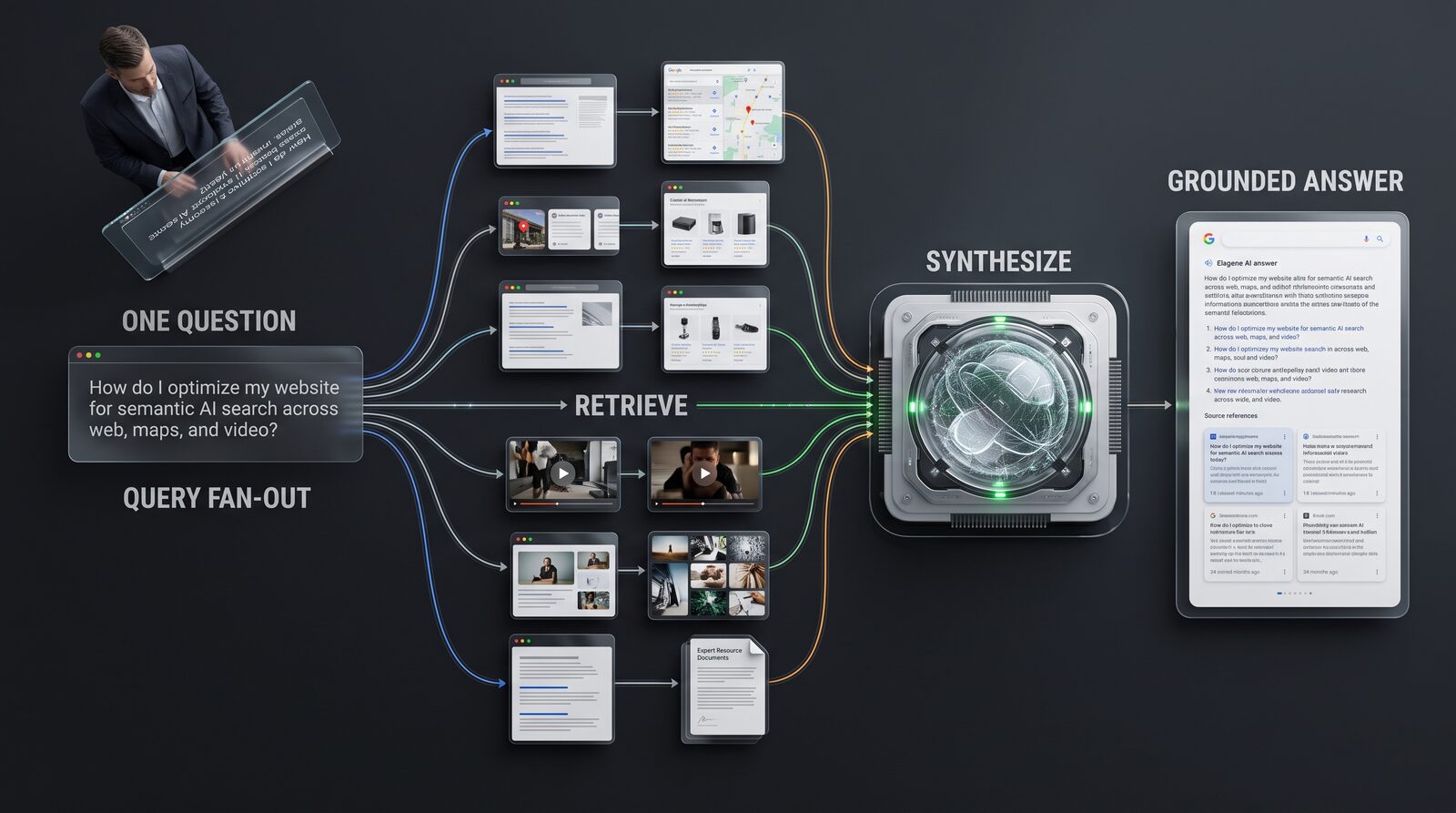
Neither is a new ranking system. Both pull from the same index that has always been there. So the same old truth holds: if a site is too thin, too messy, or too hard to trust in normal search, no AI trick fixes that. There is nothing good for the AI to check if the page underneath is not good.
The boring foundation none of this works without
A page has to be crawled, indexed, and technically sound before grounding or fan-out can start. Links a crawler can follow. Pages that load fast. A site that works on a phone. No duplicate copies of the same page fighting each other.

None of this is new. It is the same technical checklist good SEO has always run on. Skip it, and grounding has nothing to ground on.
Try it yourself
The AI-SEO myth detector
Google’s guide has a whole section calling out tactics agencies charge for that it says flatly do not matter. Here is the real verdict on each claim.
?“Add a special llms.txt file so AI can find you”
Google says its own systems do not read these files. Having one does nothing for a business in Google’s AI answers. Not better, not worse. We still keep a small one on our own site in case another AI company’s crawler checks it. But we do not pretend it moves a Google ranking, because Google itself says it does not.
?“Break your content into tiny AI-sized chunks”
Google says its systems already understand a full page fine, several topics and all. There is no magic paragraph length. Chopping a page into disconnected pieces mostly makes it a worse read for the real person who lands on it.
?“Write in a special robotic style so AI understands you”
No special sentence structure or keyword count is required. Google says its AI understands normal human language, synonyms and all, the same way a person would. Write for the customer, not the machine.
?“Get mentioned on as many random sites as possible”
Google says chasing fake “mentions” is less helpful than it looks. The same systems built to reward real authority are built to spot the trick. Quality still beats quantity.
?“Stack every schema markup type you can find”
This extra code is not required just for AI features, Google says. It is still a smart general SEO habit. Just not the shortcut to AI citation it often gets sold as.
?“Have genuinely useful, well-organized content”
The one Google keeps coming back to. Clear, honest content written for a real person helps everywhere: regular search, AI Overviews, all of it. The one item on this list worth paying for.
Five myths, one truth. If an agency’s “AI SEO” package is mostly items one through five, it is billing for homework Google already graded an F.
So what actually moves the needle?
- Same name, same address, same phone, on every directory and listing.
- AI tools lean on that match to decide who to trust, more than they used to.
- Conflicting details make a summariser hedge, or leave you out.
- Testing has found AI tools building local answers mostly from directories and review sites.
- Being accurate there matters as much as your homepage does.
- Your own website is one source in a wider mix.
- The one thing that helps everywhere, every time.
- Answer specific questions directly, in the first paragraph, with a source.
- Adding checkable citations, quotations, and figures measurably raises how often a page is surfaced.3
- Google Search Console has a Generative AI performance report.
- It shows clicks and views from AI Overviews specifically.
- It is the only source that can honestly say whether a page shows up inside Google’s AI features.
- A rank checker cannot tell you that.
By the numbers
By the numbers
- GOOGLE DOCUMENTED Google’s July 2026 AI-search guide states plainly that established SEO best practices “continue to be relevant” and that llms.txt, content chunking, and a special writing style are not needed.
- GOOGLE DOCUMENTED Search Console’s Generative AI performance report is the sanctioned way to measure appearance in AI Overviews; a rank tracker cannot.
- CONTROLLED TEST Adding citations, quotations, and statistics to a source raised its visibility in generative-engine answers by up to roughly 40% on the authors’ benchmark (Aggarwal et al., KDD 2024).
- INDUSTRY TESTING Independent local-query testing found assistants building answers largely from directories and review sites, not just the business’s own website; directional.

One more thing. Google’s guide also talks about “agentic experiences,” AI helpers that can browse a site and take an action for a customer, like booking an appointment. It is early. We are not selling a fix for it today. It is worth watching, and we would rather say that honestly than invent a product before it is real.
Does Google’s AI search guide say I need a separate AI SEO strategy?
No. It states at the top that established SEO best practices “continue to be relevant.” A business already doing normal SEO well does not need a bolted-on AI package. What shifts is emphasis, toward consistency and clear, answer-first content, not a new discipline.
Do I need an llms.txt file to appear in Google’s AI answers?
No. Google says its own systems do not read llms.txt. It does nothing for visibility in Google’s AI features. Keeping a small one for other companies’ crawlers is harmless, but it is not a Google ranking lever, and Google says so directly.
What is query fan-out and why does it matter?
Before answering, Google’s AI turns your one question into several related searches, checks them all, and blends the results into one answer. It matters because your page can be pulled in for a sub-question you were not obviously targeting, so clear coverage of the whole topic helps more than optimising one exact phrase.
How do I measure whether my pages appear in AI Overviews?
Use the Generative AI performance report in Google Search Console. It reports clicks and impressions from AI Overviews specifically. It is the only source that can honestly confirm appearance inside Google’s AI features; rank trackers and third-party tools infer, they do not measure it.
What actually helps a local business show up in AI answers?
Four things: identical business information everywhere, accurate presence on the directories and review sites assistants lean on, a clear and useful website that answers questions directly, and measuring the result in Search Console. Everything else sold as “AI SEO” is mostly the fundamentals rebranded.
Sources
- Google Search Central, Optimizing for AI features and your website (AI-search optimization guide), last updated July 2026: the sections on SEO relevance, foundational best practices, mythbusting generative AI search, measuring visibility with Search Console, and agentic experiences.
- Whitespark, Local Search Ranking Factors (2026 edition): citation-signal weighting for AI search.
- Independent 2026 testing of assistant local-query citation sources: answers built largely from directories and review sites; directional.
- Peer-reviewed: Aggarwal, P., et al. (2024). “GEO: Generative Engine Optimization.” Proceedings of the 30th ACM SIGKDD Conference on Knowledge Discovery and Data Mining (KDD ’24). On the authors’ benchmark, adding citations, quotations, and statistics to a source raised its visibility in generative-engine answers by up to roughly 40%.
Phrases in quotation marks are taken directly from Google’s published guide. Other figures are directional.
Next step
See whether AI assistants can actually find you
One client per industry, per area. The call starts with an availability check, not a pitch.