
Local Maps & AI Search Visibility for Field Trades
Grow Your Google Maps & AI Search Visibility Across Your Whole Service Area. Measured on a Live Heat Map, Not a Monthly PDF.
You can rank first at your office door and vanish two kilometres away. We run a defined 12-week roadmap that widens your Google Maps and AI search visibility across your whole service radius, tracked on a 49-point geo-grid you can open any time.
- One client per industry, per area
- Live dashboard access from day one
- No long-term lock-in contracts
Digital Handshake Media is a local SEO agency and lead generation team helping all businesses across Canada and the United States. Contact us to start.

- Google Partner
- 5-star rated on Google
- 49-point geo-grid tracking
- Real reviews only. Never bought, gated or filtered.
The reality
You might be #1 at your door. And still be losing the map.
Google says local results are primarily influenced by relevance, distance and prominence. Your customers do not all search from your business address.
So instead of asking “What do I rank?” ask “Where can my customers actually find me?” That is what we measure.
- Roofing
- HVAC
- Plumbing
- Dental
- Law firms
- Weight loss & GLP-1
- Auto detailing
- Siding & gutters
- Windows & doors
- Solar installation
- Deck & patio builders
- Concrete & paving
- Foundation repair
- Electricians
- Kitchen & bath remodeling
- Flooring
- Painting
- Water & mold restoration
- Pest control
- Appliance repair
- Auto repair
- Landscaping & lawn care
- Tree removal
- House cleaning
- Junk removal
- Window & pressure washing
- Locksmiths
- Chiropractic & physical therapy
- Dermatology & medspas
- Accounting & CPA firms
- Real estate

The three invisible map leaks
Three reasons competitors can be taking calls in the neighbourhoods you serve. None of them is a budget problem, and all three happen after the profile is already set up.
- Leak 01
You rank at your own door
Proximity is one of the two strongest ranking factors and the one nobody controls. You check from the shop, see yourself first, and assume you are visible. Two kilometres out, you can be nowhere.
- Leak 02
The profile is filled in, not built
Eight of the ten strongest Local Pack signals come straight from the Business Profile. Categories, services and attributes get entered once at setup and never revisited.
- Leak 03
Nobody is measuring the map
A rank tracker returns one number for a whole city. It cannot show coverage thickening in the east and thinning in the west, which is the thing you are actually buying.
Nine work areas. One 12-week roadmap.
Eight run inside the same 12 weeks, measured against the same baseline. The ninth, Map Check-Ins, runs alongside it as its own add-on.
- Business Profile optimizationCategories, services, attributes and hours, which is where eight of the ten strongest Local Pack signals live.
- Geo-grid measurementA baseline scan before any work starts, then recurring re-scans laid beside it.
- Website and technical workSpeed, structure and the on-page signals that decide whether the profile has anything to stand on.
- Citation and NAP cleanupOne name, one address, one phone number, consistent across the directories Google reads.
- Review strategyAuthentic collection on an ongoing basis. A sustained flow of reviews beats a burst.
- AI search optimizationBeing the local business that AI assistants cite, not just the one Google lists.
- Local contentPages written per area and per service. Never a template with the city name swapped.
- The monitoring platformDirect access to the instrument we work from, from day one. Not a monthly PDF.
- Map Check-InsEvery completed job becomes a dated, mapped record - the $299/month add-on that runs alongside the roadmap above, not inside it.
Map Check-Ins
You did the work. Now show it.
Map Check-Ins turns every completed job into a dated, mapped record on your website and Google Business Profile. $299/month, alongside the work above, not instead of it.

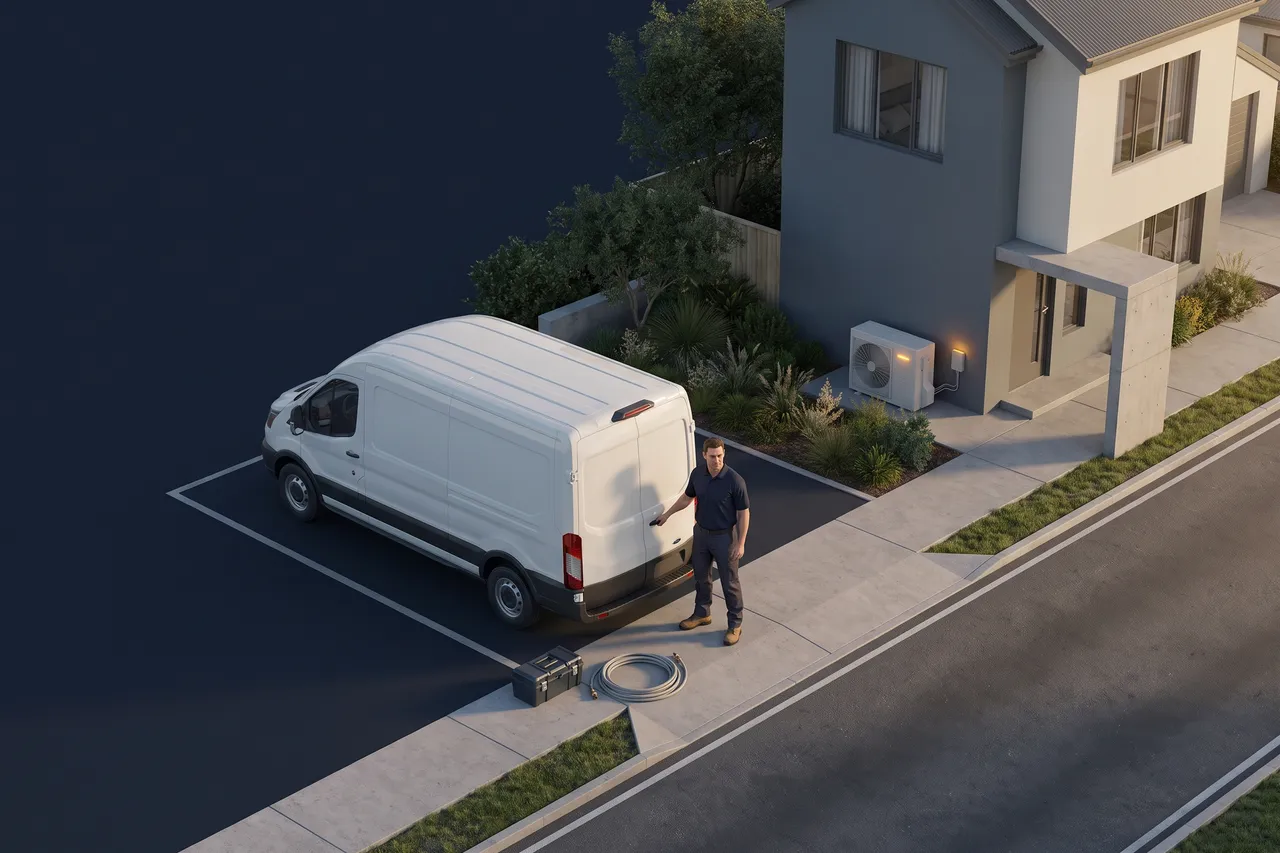 REAL WORK
It starts with a job well done.
A real technician, a real address, a finished job.
 REAL PROOF
Captured before the crew leaves.
The finished work, photographed on site while it is still there to photograph.
 REAL RECORDS
The job becomes a dated, mapped record.
Location, date, photo. Kept as proof on the website and pushed to eligible connected channels.
 REAL LOCATIONS
That record has a place on the map.
A completed job becomes a documented point in your service area, not a claim about it.
 REAL TERRITORY
The points add up to a territory.
The work you are already doing leaves a visible geographic trail across the area you serve.
 REAL MEASUREMENT
See what your customers actually see.
Local visibility is geographic. We measure it across the whole map, not from one address.
See my Google Map coverage, free

Your Google Maps rank changes every few blocks.
Search your trade from your own driveway and you may see yourself first. Search it from a customer's kitchen a few kilometres away and you may not appear at all. Google ranks local results on relevance, distance and prominence, and Whitespark's 2026 survey of local SEO practitioners puts proximity second among all ranking factors. So the one position you can see tells you almost nothing about the ones you can't. We scan your whole service area, show you the map, and document the real jobs you finish so Google and your next customer can see where you actually work.
See my Google Map coverage, freeWhat does it mean that local visibility is geographic?
- It means your Google Maps ranking is a map, not a single number. Google weighs relevance, distance and prominence, and proximity ranks second among local pack factors in Whitespark's 2026 survey. The same business can be first at its storefront and missing a kilometre away. Measuring local visibility means checking many points across the service area and reading the pattern, not quoting one rank.
How do I see my own Google Maps ranking across my service area?
- Search your main service from three or four different parts of your service area in a private window, and note who holds the top three listings each time. Our free Map Pack audit does the same thing properly: a hand-run geo-grid scan for up to three keywords, with no access to your accounts needed.
Does documenting completed jobs guarantee higher Google rankings?
- No. Documenting real work, sometimes called Map Check-Ins, is a proof and visibility layer, not a ranking guarantee. Local search visibility depends on relevance, distance, prominence, the Google Business Profile, the website, and other signals.

Need the website itself built first?
Everything above assumes there’s already a site worth ranking. If yours is outdated, or you don’t have one yet, that’s a separate, fixed-price build: a Search-Ready Website from $1,500 USD, with the search architecture already wired in, and $3,000 or more for competitive niches and multi-location businesses.
Fig. 01 - Where you show up on the map · checked from 49 spots
Week 0
The starting picture
Before we change anything, we check where you show up on the map from 49 spots around your area. That is the picture every later result is compared to, good or bad.

The instruments
Four things you can run before you talk to us
The instruments are published, not demonstrated. Two of them can end with you deciding against hiring anyone.
- 49 pointsThe scanYour coverage across the service area, measured before any work starts and again at week 12.See how it moves ›
- 5 questionsFit checkSixty seconds, and it will tell you not to hire us if that is the honest answer.Run it ›
- 2 numbersThe arithmeticYour job value and the jobs you would expect. It runs in your browser and sends nothing.Run it ›
- 12 pointsMap Pack CheckThe whole checklist we work from, published in full so you can do it yourself for nothing.Open it ›

One client per industry, per area
Two roofers in the same city cannot both be moved to the top of the same grid.
12-week roadmap
A defined window with a baseline scan at the start and a comparison at the end.
No guaranteed rankings
Google's own guidance warns against any SEO who promises a position. So do we.
Digital Handshake Media is a local SEO agency headquartered in Vancouver, British Columbia, serving local service businesses across North America. It runs a 12-week roadmap to grow Google Map Pack and Google Maps visibility: your Google Business Profile, the website and technical signals behind it, your citations and NAP data, and how AI assistants describe your business. Progress is measured with recurring geo-grid heat map scans compared against a baseline, inside a dashboard the client can open themselves. The agency takes one client per industry, per area, and does not guarantee specific rankings. Call 778-200-8644 or book a free market assessment.

Three listings decide who gets the call
Someone with a burst pipe or a toothache is not researching. They are choosing. They see three names with star ratings and a call button, and pick one. Positions four and below are not losing a share of that customer. In most cases they were never seen at all.
Google names three factors behind local ranking:
Relevance
Does the business match what the searcher typed?
Distance
How close is the business to the searcher, or the area they searched?
Prominence
How well-known and established does the business appear, based on signals like reviews and links?
Google does not publish exact weights. The figures below are third-party survey estimates, useful for prioritizing where to spend effort, not a decomposition of the algorithm - which is also why they do not sum to 100.
Read the full 2026 local ranking factors breakdown › · See the full Google Maps SEO method ›

Measurement
The instrument, not a summary of it
A business can sit first at its own address and vanish two kilometres away, because Google weighs proximity. So we measure on the map itself: a grid of ranking checks across your service area, scanned before any work begins and re-scanned on a recurring basis, so coverage change is visible as geography.
You get direct access to that platform, not a filtered summary of it. A dedicated account manager walks the metrics with you.
You do not have to trust a summary. The heat map either got greener across your service area or it did not, and you are looking at the same screen we are.
Week 0Starting picture
Week 12Measured scan
- Top 5
- 6-20
- 20+
- Your office

Three steps, and a number to check them against
The baseline is taken before anyone is paid to improve it. That ordering is the whole point.
- Step 01
The starting picture
Before any work begins, we check where you show up on the map from points across your area and save it. That is what every later result is measured against, whether it makes us look good or not.
- Step 02
The 12-week plan
Your Google listing, then your website, then your listings across the web, then reviews and local content. A set 12 weeks, not a bill that never ends. You can open the tracking screen from day one, not at the first report.
- Step 03
The re-check
The same points on the map, checked again, set next to the starting picture. Your spot on the map grew across your area or it did not, and you are looking at the same screen we are.

What we don’t do
Naming this matters more than any promise we could make.
We don't guarantee top 3 placement
It happens often, but it depends on niche, proximity, competition, reviews, website quality and how involved you are. Google's own documentation warns businesses about SEOs who guarantee rankings. Here is the long version.
We don't geotag photos
Google strips EXIF location data on upload, and controlled tests across 27 locations found no ranking effect. Some locations declined. Anyone selling you geotagging is selling a tactic that was disproven years ago.
We don't buy or fabricate reviews
They violate Google's policies and Canada's Competition Act, and they get filtered. You collect authentic ones; we build everything around them.
We don't sell backlink packages
Focus stays on citations, NAP consistency, profile optimization, technical work and local content.
We don't publish copy-paste city pages
Duplicated location pages create quality problems rather than solving them.
We don't make risky profile changes without approval
Especially to name, address, phone or primary category, where a mistake can trigger suspension.
The comparison
What you are actually buying
Most of the difference is not in the work. It is in what you are allowed to see while it happens.
| What you are buying | Typical local SEO retainer | Digital Handshake Media |
|---|---|---|
| What you are shown | A monthly PDF report | Direct access to the monitoring platform |
| How progress is measured | An average rank for the whole city | A geo-grid re-scanned against your baseline |
| Ranking promises | Top 3 guaranteed | None. Google warns against anyone who does |
| Photo geotagging | Sells EXIF geotagging as a ranking trick | Doesn't. Google strips that data on upload |
| Your competitor down the road | Also a client | One client per industry, per area |
| Shape of the engagement | Open-ended retainer | A 12-week roadmap with a defined window |
| Who walks you through it | A shared inbox | A dedicated account manager, on the metrics |
Google is the referee. It decides local rankings from relevance, distance and prominence, and no agency can pay it for a better spot. We are the scorekeeper: we build the profile, site and local signals that give Google real evidence to work with, and we keep score on a map you can open yourself.
Five questions. It can tell you not to hire us.
Roughly a third of the assessments we run end in a no. You may as well find that out here.
Question 1 of 5
Are you an established local service business with customers you already serve?
Local SEO captures demand that exists. It cannot manufacture it for a business that has not launched.
The long version of that fit check
When to choose this model
- You are an established local service business already investing at least $1,000/month in growth.
- Competitors visibly outrank you on Google Maps in areas you can actually serve.
- You could handle a meaningful increase in calls next quarter.
- You can collect authentic reviews and supply job photos on an ongoing basis.
- You want a defined roadmap with visible measurement, and a partner who will tell you what is realistic.
When it isn’t
- You need brand-new demand created for an unproven service. Local SEO captures demand; it does not invent it.
- You are pre-launch with no customers who could review you.
- You want a guaranteed position. We will not sell one, and you should be wary of anyone who will.
- You want a broad national brand campaign. Different problem, different tools.
- The budget is not there this quarter. Work the Map Pack Check yourself in the meantime.
Whether it pays is a sum, not a feeling
Local SEO is worth doing when one additional job a month covers it and the rest is margin.
Then check the arithmetic
Two numbers you already know. Nothing is sent anywhere. This runs in your browser.
Enter both numbers to see what the channel would need to return.
Industry playbooks, not swapped keywords
A roofing campaign and a dental campaign share a method and almost nothing else.

Roofing
Three different homeowners are searching for you, and storm season rewards preparation over reaction.
Read the playbook ›
HVAC
Two demand spikes a year, an install-versus-repair split, and a maintenance base that decides the margin.
Read the playbook ›
Plumbing
The most emergency-weighted local search there is. Speed of answer beats almost every other factor.
Read the playbook ›
Dental
New-patient searches, insurance friction, and the college advertising rules most agencies ignore.
Read the playbook ›
Law firms
The most contested local vertical in search, with law-society advertising rules layered on top.
Read the playbook ›
Weight loss & GLP-1
Patient acquisition built inside advertising and privacy requirements, where retention decides the business.
Read the playbook ›Evidence
A criminal defence practice in San Diego, over three months
One of the most contested local verticals in North American search. Google Business Profile figures for February to April 2026, taken from the client’s own profile.
Frequently asked questions
What is the Google Map Pack?
The Google Map Pack (also called the Local Pack) is the block of three local business listings, shown with a map, that appears at the top of Google results for searches with local intent: “plumber near me,” “dentist in Surrey,” “roof repair Austin.” It sits above the traditional organic results, so the three businesses in it capture most of the calls and direction requests for that search.
Is SEO dead in 2026?
No. Search did not go away, it split into three parts on one results page: the traditional blue links, the Google Map Pack, and the AI answer at the top. The work that earns one tends to earn all three: a correct Google Business Profile, real recent reviews, and clear pages a machine can read. What stopped working is the old tricks, like keyword stuffing and bought links. The full breakdown is here.
Do you guarantee a top 3 ranking?
No, and we would walk away from anyone who insisted on one. A top 3 spot happens often, but it depends on how busy your trade is, how close the searcher is, your reviews, your website, your listing, and how active you stay. No agency controls those. Google itself tells business owners to be wary of anyone who promises a ranking. What we promise is that more of the map turns green over the 12 weeks when the plan is followed and you send us what we ask for, checked against your starting picture.
Does geotagging my job photos improve my Google Maps ranking?
No. Google strips the location data hidden inside a photo (its EXIF data) when the photo is uploaded, and controlled tests across 27 locations found no ranking effect, with some locations declining. We do not sell it. What Map Check-Ins does instead is publish a dated, mapped record of each job on your own website, with structured data the search engines can read directly. Here is how Map Check-Ins works.
What is a heat map and why use it instead of a ranking report?
One “rank” number does not tell you much in local search, because Google leans hard on how close the searcher is. You can be first at your own shop and invisible three kilometres away. A heat map checks where you show up from dozens of points across your area and colours each one, so you see it as a map, not a number. We take a starting picture before any work begins, then check again on a set schedule and compare.
How long before we see movement?
The plan runs 12 weeks. Listing changes, like fixing your category or your hours, can move things in the first few weeks. The slower work, like reviews, content and links, usually shows between weeks 6 and 12. A busy trade, a listing that has been penalised, or slow access to your accounts all push that out, and we tell you at the assessment, not after.
What if I have a lot of Google reviews already?
A large number helps, but it is not the whole signal. In Whitespark's 2026 survey of 47 local SEO practitioners, a high Google rating ranks sixth among Local Pack factors, the quantity of reviews ninth, their recency eleventh, and a steady flow over time rather than bursts fourteenth. Those are independent expert estimates, not Google figures. So the work is not chasing a bigger pile. It is keeping an authentic stream of reviews from recent customers going.
What does it cost?
Engagements are built for businesses investing at least $1,000 per month in growth. Actual pricing depends on the competitiveness of your industry and service area. A niche service in Delta is a different project than a personal injury firm in downtown Vancouver. Pricing is published here. Below that floor, the honest recommendation is to work our Map Pack Check yourself.
Is there a long-term contract?
No. The roadmap is scoped as 12 weeks, then continues month to month unless you agree otherwise, and we will not lock you into a long contract. Map Check-Ins, at $299 a month, is month to month and you can cancel any time. Our ground rules are written down here.
Do you really only take one client per industry per area?
Yes. Two roofers in the same city cannot both be moved to the top of the same grid, and an agency that takes both is charging two clients to compete with each other. When a territory is taken we say so and decline, which is why the assessment call starts with an availability check.
Do you work outside British Columbia?
Yes. We work with local service businesses across Canada and the United States. The method is identical because the Map Pack works the same everywhere. We are based in Vancouver, BC, and we hold dedicated market pages for the Metro Vancouver cities we know in the most detail.
What happens if rankings improve but calls don't?
It means visibility improved while something downstream limited conversion: market demand, seasonality, your offer or pricing, review sentiment, the website visitors land on, or how calls are handled when they arrive. Local SEO increases opportunities; it does not create demand that isn’t there. That diagnosis is part of the monthly review, not an upsell.
Why does everyone say a ranking guarantee is a red flag?
Because it is a promise about something the person promising it does not control, like a taxi driver guaranteeing you hit every green light. Google sets the lights, and it changes them several times a year. The full reasoning is here, including the Canadian legal angle most guarantees quietly ignore.
I just want to see where I actually rank before I talk to anyone. Can I?
Yes, two ways, both free and neither needs a call. Map Pack Check scores your Google Business Profile against our 12-point checklist and models a geo-grid in your browser. The Geographic Gap Diagnostic takes two minutes and tells you the size of the gap between where your crews work and where Google actually shows you.
Find out whether your industry is still open in your area
We take one client per industry, per area. Book your free market assessment (roughly 30 minutes) and see the 49-point geo-grid for your territory before a competitor claims it.
- 100% confidential
- Zero obligation, no slide-deck pitch
- Includes a 49-point geo-grid scan of your territory
P.S. Your market assessment is free, includes a 49-point geo-grid scan of your actual territory, and carries zero obligation. We only take one business per industry, per area, so if a competitor books first, your area may no longer be available. Book your market assessment before they do ›
Want to look first? Run the free Map Pack Check.