
Sauce · Case Study
A San Diego law practice went from 10 profile visits a month to 81. Here’s the whole mechanism.
Quick answer
A San Diego criminal defence practice ranked well from its own office and was effectively invisible everywhere else, a classic proximity gap. Over a three-month window we corrected the profile’s category and services, fixed hours accuracy, ran a baseline geo-grid scan with recurring re-scans, cleaned up citations, and built a real review cadence. Monthly profile interactions went from about 10 to 81. This is the real, published data, not a rounded-up version, and it includes the parts that did not go smoothly.
Want to see your own market before spending anything?The free 49-point scan runs the same baseline geo-grid we started this engagement with.
Get the free scanSearch for your own business from your own office and you will probably rank well. That tells you almost nothing about what a customer three kilometres away sees.
A San Diego criminal defence attorney found this out the direct way. Criminal defence in a major US metro is one of the harder local search environments there is: competing firms have decade-old profiles, hundreds of reviews, and budgets a single practitioner cannot match. This client’s reputation in court was well ahead of his visibility on the map, a common and expensive gap. This is the already-published record of what changed, with the caveats included.
What a ranking screenshot does not show you
A screenshot from a business’s own address proves the business can find itself. It does not prove a stranger three neighbourhoods over can. Google’s guidance is explicit that local ranking runs on relevance, distance, and prominence, and that there is no way to pay for a better position.1 Distance is exactly the factor a flattering screenshot hides.
Before touching anything, we ran a baseline geo-grid scan: coverage measured across the metro rather than from one address, so every later claim could be checked against a real starting point. The opening weeks were the slowest part of the curve. February showed minimal interaction; the profile was live but effectively invisible. That is the honest shape of local SEO. Category and profile work land first, prominence from reviews and citations compounds behind it, and the visible payoff tends to arrive in weeks six through twelve, not week two.
Across the full three-month window: 271 total profile interactions, 166 direction requests, 42 calls placed. The full published case study →
What we actually changed
Nothing on this list is exotic. That is close to the whole point.
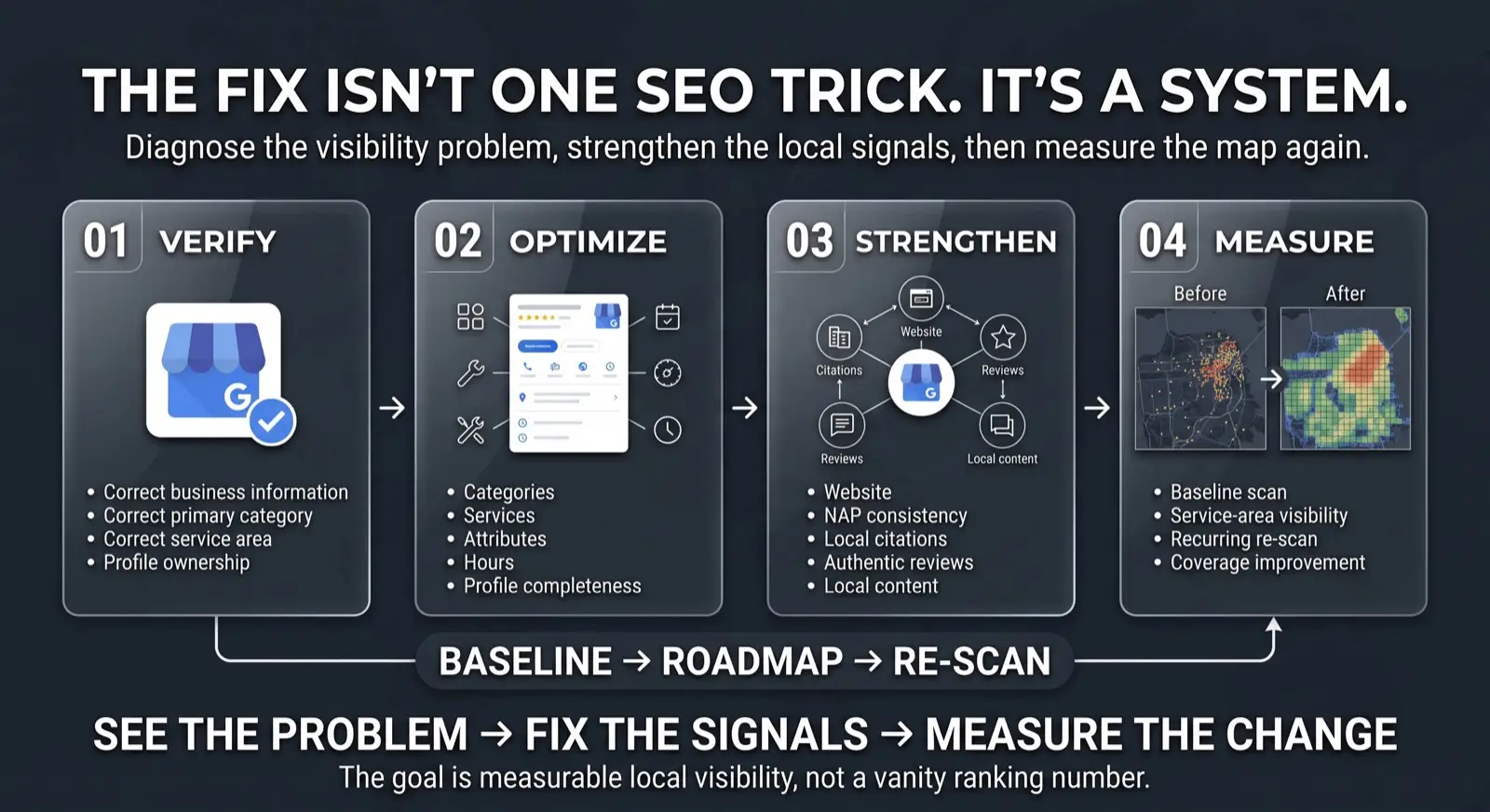
- Primary category and services. The strongest relevance field, corrected first, using Google’s predefined service entries rather than free text.
- Service area and hours accuracy. Being open at the moment of the search is among the top five Local Pack factors, and legal searches skew toward evenings and weekends, when someone has just been arrested or charged.
- Baseline geo-grid scan, then recurring scans. Coverage measured before anything was touched, so every later claim could be checked against it.
- NAP and citation cleanup across legal directories, where attorney listings are unusually prone to old addresses and stale tracking numbers.
- Review cadence and responses. The client committed to asking consistently and responding to everything that arrived.
- Schema and entity clarity in the final weeks, so assistants could verify the practice, its location, and its practice areas independently of the profile.
- Category and hours are relevance; they gate whether you appear for the right searches at all.
- Citations and reviews are prominence; they compound slowly, so they start early and pay late.
- The baseline scan comes first so improvement is measured, not asserted.
- Schema and entity work last, once the facts it points to are already correct.
- Calls did not rise smoothly; there was a real mid-window dip before April’s jump to 18.
- Three months is a short window and spans a seasonal pattern legal practices genuinely experience.
- Some portion of the movement is therefore not attributable to us.
- We report profile-interaction data because that is what we can evidence; we did not measure revenue and do not claim it.
- AI assistants read structured, verifiable facts, not advertisements.
- They weigh consistent third-party citations over a business’s own claims.2
- Category accuracy, clean citations, and clear entity data are the same foundation as the Local Pack position.
- It is not a separate project bolted on afterward.
By the numbers
By the numbers
- DHM DATA Monthly Google Business Profile interactions rose from about 10 in February to 81 in April 2026.
- DHM DATA Across the full February–April window: 271 total profile interactions, 166 direction requests, 42 calls placed; 18 of those calls in April, the strongest month.
- GOOGLE DOCUMENTED Local ranking runs on relevance, distance, and prominence, with no way to pay for a better position.
- DHM INTERPRETATION February was near-flat. The curve is slow first, then compounds. A case study that shows a straight line up is hiding the first six weeks.
The same signals now decide whether AI assistants mention you
AI assistants do not read advertisements. They read structured, verifiable facts published across the web, and they weigh third-party citation consistency more heavily than a business’s own claims about itself.2 Category accuracy, consistent citations, and clear entity data are not a separate AI-search project. They are the same foundation the Local Pack position was built on. More on AEO and GEO →
What we would flag if we were grading our own work
Calls did not rise smoothly. There was a real dip in the middle of the window before April’s jump to 18, which we did not predict and which took a cycle to diagnose. Three months is a short window, and it spans a seasonal pattern legal practices genuinely experience, so some of the movement is not attributable to us. We report profile-interaction data because that is what we can evidence. We are not claiming a revenue figure we did not measure, and we would not trust a case study that did.
Find your starting point
Which of these sounds like your business?
Pick the one closest to where you actually are.
You rank well from your own office
Run a free scan and see what the rest of your market actually sees.
Get the free scan › $299/moYou want the proof layer, not a full roadmap
Map Check-Ins turns finished jobs into dated, mapped proof.
See Map Check-Ins › 12-week roadmapYou want the full mechanism, run for you
Book a market assessment and see if your territory is still open.
Book the call ›If you want the mechanism without the full engagement
The category, hours, citation, and review work above ran as a full 12-week roadmap. Not every business needs that. If the specific gap is proving distance, dated evidence that a business is actually active in the neighbourhoods it wants to rank in, Map Check-Ins is the productized version of that one mechanism: field photos, timestamped and pinned to a location, published to the site and the Google Business Profile as jobs happen.

The honest part
Nobody can guarantee a top spot on Google Maps, including us, and a case study that implies otherwise is not one to trust. What we can do is show the actual mechanism and the actual numbers, slow start included, and let the shape of the curve speak for itself.
Are these San Diego numbers real?
Yes. Monthly Google Business Profile interactions went from about 10 in February 2026 to 81 in April 2026, with 271 total interactions, 166 direction requests, and 42 calls across the window. The full data and methodology are on the results page. We report profile-interaction data because that is what we can evidence; we did not measure revenue and do not claim it.
Why was the first month almost flat?
Because that is the real shape of local SEO. Category and profile work land first; prominence built from reviews and citations compounds behind it. February showed minimal interaction while the foundation was being set. The visible payoff arrived in the back half of the window, weeks six through twelve, which is typical.
What specifically was changed on the profile?
Primary category and predefined services, service-area and hours accuracy, a baseline geo-grid scan with recurring re-scans, NAP and citation cleanup across legal directories, a consistent review cadence with responses, and schema and entity clarity in the final weeks. Nothing exotic; the order and the consistency did the work.
How much of the improvement can you actually attribute to the work?
Not all of it. Three months is a short window and it overlaps a seasonal pattern legal practices genuinely see, so some of the movement would have happened anyway. We say so in the case study. The mechanism and the direction of the curve are what we stand behind, not a precise attribution percentage.
Do I need the full 12-week roadmap to get a result like this?
Not always. This engagement ran the full roadmap because the profile needed category, hours, citation, and review work together. If your specific gap is just proving activity across a service area, Map Check-Ins is the productized version of that one mechanism at $299 a month.
Sources
- Google Business Profile Help, Improve your local ranking on Google: relevance, distance and prominence; no way to pay for a better position.
- Brandlight, GEO source-overlap analysis (top Google rankings versus AI-cited sources), industry analysis: AI answers lean on consistent third-party sources over first-party claims.
- Digital Handshake Media, published case study and full Google Business Profile interaction data, February–April 2026.
- Whitespark, Local Search Ranking Factors (2026 edition): hours (open-now) as a top-five Local Pack factor.
- Peer-reviewed: Lewandowski, D., & Kammerer, Y. (2021). “Factors influencing viewing behaviour on search engine results pages: a review of eye-tracking research.” Behaviour & Information Technology. doi:10.1080/0144929X.2020.1761450. Narrative review of 41 eye-tracking studies; position bias is reported across studies.
The San Diego figures are Digital Handshake Media’s own measured profile-interaction data for one client, February–April 2026. Other figures are quoted from the published sources above and are directional.
Next step
See what your market actually looks like before you spend anything
One client per industry, per area. The call starts with an availability check, not a pitch.