
Sauce · Google Business Profile
GBP optimization: the advanced settings that move Map Pack visibility
Quick answer
Past the basics, GBP optimization is about four levers: category hierarchy (the primary sets eligibility, well-chosen secondaries widen it without diluting it), attribute selection (a handful genuinely correlate with visibility for their query type, the rest are trust and conversion signals), posting cadence (a freshness signal with a short half-life, not a ranking lever), and photo rules (real, recent, geo-relevant, no baked-in text). None of it is guesswork if you test it against a geo-grid baseline and change one variable at a time.
Testing profile changes without a baseline is guessing.The free 49-point scan gives you the geo-grid starting point every controlled test needs.
Get the free scan“Optimize the Google Business Profile” is on every local SEO checklist. Almost none of them say which settings actually move the map, or how to tell.
If you manage profiles for a living, you have hit the ceiling of surface tips. This is the layer below: the configuration decisions that change eligibility and prominence, and how to test them without fooling yourself.
Lever 1: category hierarchy
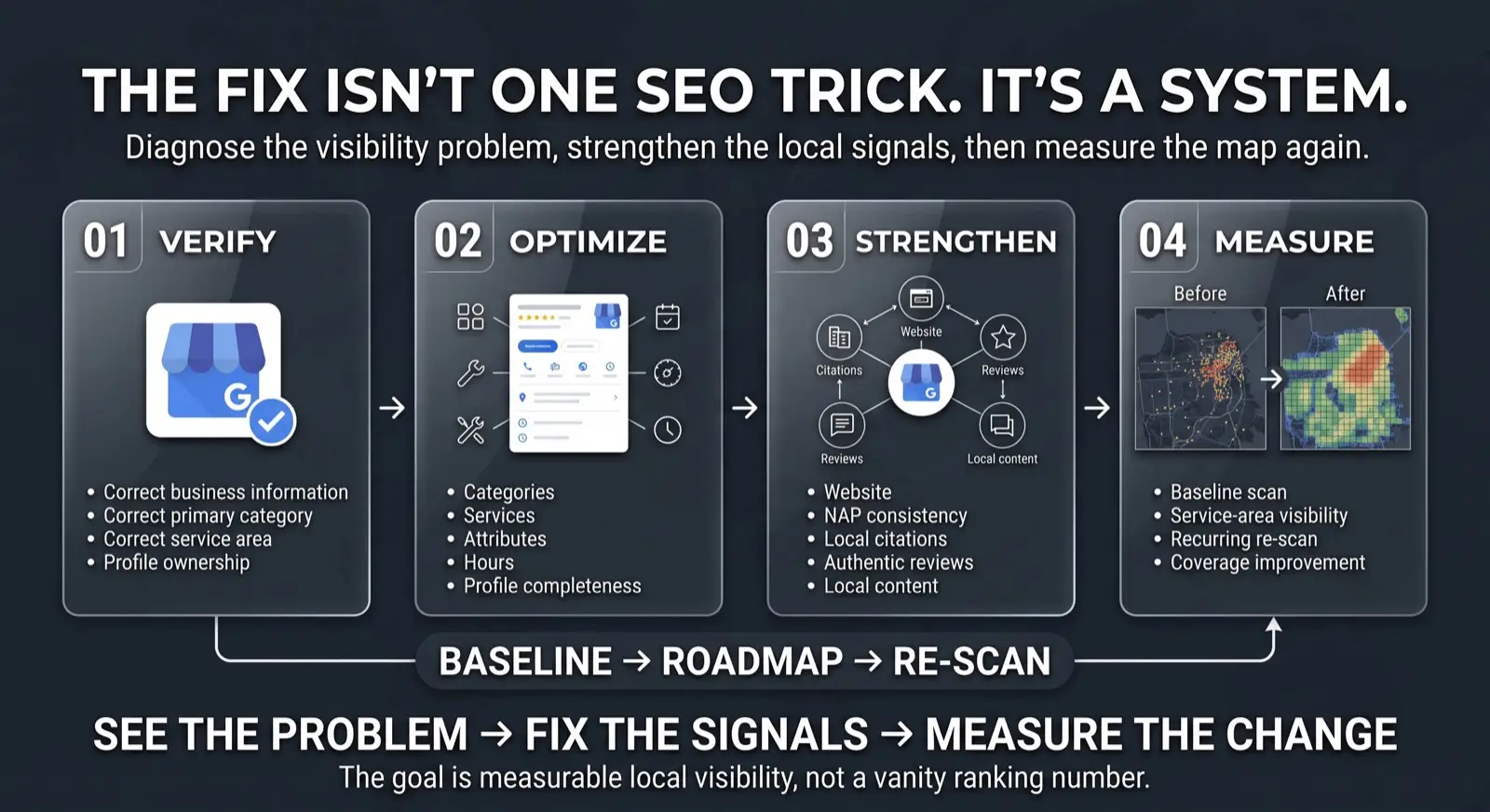
The primary category is the single highest-impact field on the profile. It defines the core set of searches you are eligible to appear in. Choose the most specific option that still describes your main service. Too broad and you compete in a larger, more contested set with a weaker relevance match. Too narrow and you miss adjacent demand.
Secondary categories add eligibility for related searches. They matter more than most owners think, and they are misused more than most managers admit. The rules that hold up in testing:
- Every secondary must be a service you genuinely perform. Google can and does act on categories that do not match the on-the-ground business.
- Order does not set priority the way people assume, but relevance of each secondary to your actual services does.
- Three to five well-matched secondaries generally outperform a padded list of ten loosely-related ones.
- Changing the primary on an established profile can trigger a re-review, so treat it as a deliberate, measured change, not an experiment.
Test it: baseline the geo-grid, add one relevant secondary, wait two to three weeks, re-scan. Attribute the change only if nothing else moved. The category deep-dive.
Lever 2: attribute selection
Attributes fall into two groups. A minority behave like relevance signals for their query type: “identifies as” attributes, “open 24 hours”, service options like “online estimates” or “on-site services” when someone searches with that intent. The majority, payment types, accessibility, amenities, are trust and conversion signals that influence whether a searcher chooses you, not whether you appear.
Set for visibility
- Service options that match how people search: on-site, online, in-store.
- “Identifies as” attributes, where relevant and true.
- 24-hour or emergency availability when it applies.
- Anything that maps directly to a query someone would type.
Set for conversion
- Payment types, free estimates, warranty offered.
- Accessibility and parking.
- Languages spoken, appointment required.
- These do not move rank; they move the click once you rank.
Rule: set every attribute that is true. Do not claim ones that are not. The visibility-linked ones are a small subset; the rest still earn their place by lifting conversion.
Lever 3: posting cadence
Google Business Profile posts are a freshness signal with a short half-life, not a ranking lever. Posting keeps the profile looking active and gives a searcher something current to read. The pattern that works without wasting effort:
- One genuine post a week is plenty. A completed project, a seasonal note, a real offer.
- Consistency beats volume. Four thin posts a week does nothing three does not.
- Include a photo from the actual job and a specific location where you can.
- Do not keyword-stuff the post body. It reads as spam to the searcher and does not help ranking.
If posting stops entirely, the profile does not get penalised. It just stops producing the freshness signal, and competitors who keep posting look more active by comparison.
Lever 4: photo optimization
New photos are a freshness signal. A profile getting fresh job photos every week reads as active. Aim for a few a month at minimum.
Phone numbers, prices, promotional overlays and logos plastered across the photo are a suspension risk and get filtered. Let the photo be a photo.
Google strips location metadata on upload. Where a photo “is” comes from the page, caption and post it sits in, not embedded GPS. Geotag services are selling a signal that never arrives.
Exterior, interior, team, work in progress, finished result. A profile with only a logo and a stock image looks thinner than one showing real work across the service area.
How to run a controlled profile test
- Baseline the geo-grid for the target queries, same day, same grid.
- Change one variable. One secondary category, or one attribute set, or a posting cadence, not several at once.
- Wait two to three weeks. Map Pack changes are not instant.
- Re-scan on the same grid and compare. Note anything else that changed in the window (a competitor, a review spike) before attributing the movement.
- Keep a log. Over a few cycles you build a real picture of what moves this profile in this market, which is worth more than any generic checklist.
Related
Where this connects
The basics, the category detail, and the measurement.
Want the low-hanging fruit found for you?The free scan audits the profile settings above against a live geo-grid and flags the immediate wins.
Get the free scanDo secondary categories help Map Pack rankings?
Yes, when they match services you genuinely perform. Secondaries extend the set of searches you are eligible for without weakening your primary category. Three to five well-matched ones generally outperform a padded list of ten loosely-related ones.
Which Google Business Profile attributes affect visibility?
A minority behave like relevance signals for their query type: service options like on-site or online estimates, 24-hour availability, and "identifies as" attributes where relevant. Most attributes, payment types, accessibility, amenities, are trust and conversion signals that affect whether a searcher chooses you, not whether you appear.
How often should I post on Google Business Profile?
About once a week, with a real photo and a specific location where possible. Posting is a freshness signal with a short half-life, not a ranking lever, so consistency beats volume. Stopping does not incur a penalty; it just removes the freshness signal.
Does adding photos to my Business Profile improve ranking?
Fresh photos are a freshness signal and make a profile look active. They do not carry embedded location data, Google strips it on upload, so geo-relevance comes from the page, caption and post the photo sits in. Never bake phone numbers or prices into the image.
How do I know which profile change actually moved my ranking?
Run a controlled test: baseline a geo-grid, change one variable, wait two to three weeks, re-scan on the same grid, and note anything else that changed in the window before attributing the movement. Keep a log across cycles.
Sources
- Google Business Profile Help, Guidelines for representing your business on Google: category, name and content rules, and what leads to suspension. Read it
- Google Business Profile Help, Improve your local ranking on Google: relevance, distance and prominence decide local results; complete, accurate information helps.
- Whitespark, Local Search Ranking Factors (2026 edition): the primary category is consistently rated the single strongest Google Business Profile factor, with services and secondary categories also high.
- DataForSEO, SERP datasets (2026): local pack composition for the same query changes with the coordinates attached to the request, which is why profile tests must be measured on a grid.
- Peer-reviewed: Christophides, V., et al. (2021). “An Overview of End-to-End Entity Resolution for Big Data.” ACM Computing Surveys 53(6). Consistent identifying attributes across sources are what let a system attribute signals to one entity confidently.
Attribute and category behaviour is inferred from testing and published guidance; Google does not disclose the ranking formula. Treat specifics as directional.
Next step
Audit the profile against a live geo-grid
The free scan checks the category setup, attributes, posting and photos against your real Map Pack coverage, and flags the changes most likely to move it.